Why there is research on limerence
This is a mirror of a Medium article here: https://medium.com/@shiverypeaks/why-there-is-research-on-limerence-8aa3edbed0fd.
My name is David and I write Wikipedia articles about romantic love, including “Limerence”, “Romance”, “Biology of romantic love”, “Reward theory of attraction”, “Obsessive love” and “Love addiction”, which I recommend reading.
Also see my article “The state of romantic love”, about the history of semantic issues around the term “romantic love”, which Tom Bellamy was generous enough to post on his website.
In this article here, I’m going to explain how to understand what scientific research is relevant to limerence, and also explain the history of why people on the internet think there isn’t any.
Dorothy Tennov is highly cited in the literature on romantic love, and actually many authors have written about limerence (even from a clinical perspective). Academics on love unanimously consider Tennov’s book to be a canonical work on passionate love.
The confusion over this is largely semantic, over how Tennov wanted the term to be used, because not all authors have understood the exact type of distinction she was trying to make. The dearth of actual studies then is more so on unrequited love.
However, additionally, now there is also a history of certain authors spreading outright misinformation about this.
I do not cite things in a misleading way, so everything I’m about to say here is well-founded if you read my citations. In summarizing research here, I am summarizing the perspective of romantic love PhDs.
A lot of this is actually just a question of which sources you are going to believe, but people on the internet don’t seem to understand how credentials work in psychology. Only somebody with a PhD specifically in romantic love would be a very credible source on something like this. You would also have to check into what kind of research the person is publishing, what their citation counts are, which journals they publish in, and even check their citations (to make sure they don’t cite things in a misleading way) to know for sure. Pretty much everyone talking about limerence these days fails spectacularly in this way, if you check into what their actual credentials are, and check their citations.
Sometimes people ask about the Wikipedia article, wondering if it’s correct. It is correct, because it’s carefully written using only sources which are reliable. Essentially all I do is vet sources like this. Editors are not supposed to interpret scientific studies, only vet sources and summarize what other people have already written. The citations say what the article says.
What the controversy is even about
In psychology research, a construct is often discussed, called “passionate love” (Hatfield, 1988, p. 191):
Hatfield and Walster (1978) define passionate love this way: “A state of intense longing for union with another. Reciprocated love (union with the other) is associated with fulfillment and ecstasy. Unrequited love (separation) with emptiness, anxiety, or despair. A state of profound physiological arousal.”
Many scholars on romantic love have considered this synonymous with limerence (e.g. Hatfield, 1988, p. 197; Fisher et al., 2002; Acevedo & Aron, 2009), and also terms like “being in love” and “infatuation”.
Tennov herself acknowledges this, but then sometimes complains that these terms also refer to other things besides limerence (e.g. Tennov, 2005, p. 14):
“Limerence” is an identifiable and invariant condition that afflicts persons identically whenever it occurs and is mainly characterized by a unique form of cognitive preoccupation. The condition is commonly referred to as “being in love”, “romantic love”, or “passionate love”. Those terms may also refer to states other than the state identified as “limerence”.
Why does she say stuff like this?
Limerence is not entirely distinct from being in love
First, Tennov’s basic distinction is simply that “limerence” was specifically meant to refer to passionate love outside of a relationship, whereas most academics on love (such as Helen Fisher) generally use “passionate love” to refer both to this, and also to being in love during the early period of a relationship.
Because academics usually mean to write about both things together (inside and outside a relationship), this means that the research literature on passionate love is supposed to include limerence as part of their theory.
Most academics on love therefore make a distinction between reciprocated love (a relationship) and unrequited love. Tennov’s distinction is only slightly different: “limerence” essentially refers to falling in love before, rather than after a relationship starts.
Why does she do this? Tennov set out to study lovesickness and unhappy love, which she believed was the result of a biological process evolved for the purpose of mating. Therefore, she defines “limerence” in a way which allows it to turn ecstatic in case it turns into a relationship. Another way to put it is that limerence is defined as starting unfulfilled, rather than unrequited. It can be unrequited, but it can also actually be unfulfilled and reciprocated at the same time (as in Romeo and Juliet).
However, Tennov has a way of thinking about this which makes her material difficult to interpret.
Tennov came to believe (based on her interview methods) that limerence is somehow distinct from other ways of being in love, although the scientific research disproves this. There are three studies I know of (Feeney & Noller, 1990; Wolf, 2017; Langeslag, 2024) which demonstrate that every time anyone has tried to measure limerence, it’s been correlated with other measures of romantic love: for example, the Passionate Love Scale (PLS), Love Attitudes Scale (LAS), and Infatuation and Attachment Scales (IAS). The only way to object to this line of evidence is to retreat into unfalsifiable claims, like that nobody has designed a sufficient measure yet.
A survey by the researcher Adam Bode also demonstrates that obsessive thinking and PLS scores are normally distributed, rather than bimodal. This makes a distinction between limerence and nonlimerence in terms of intensity somewhat unclear.
The following images were created by Bode from his Romantic Love Survey 2022 data (used with permission):
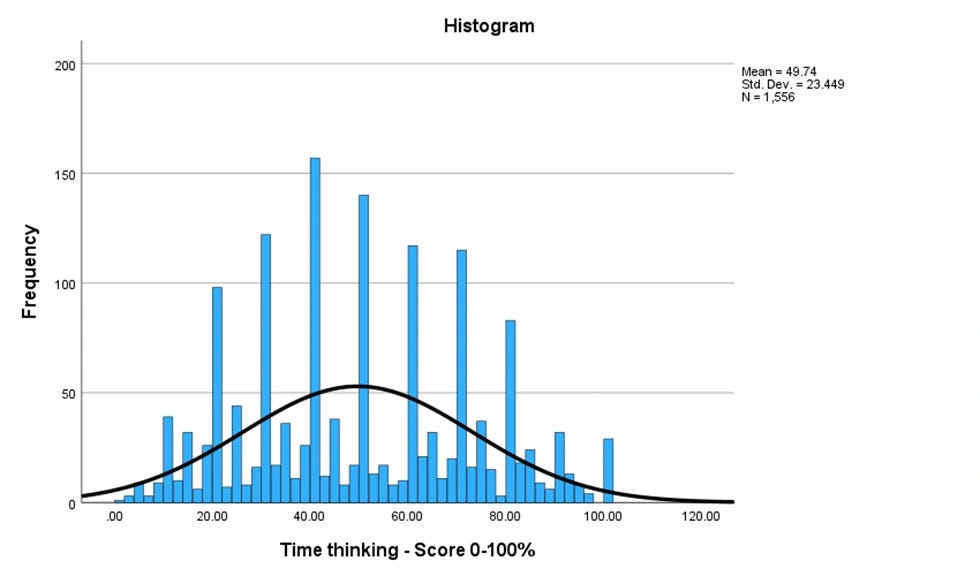
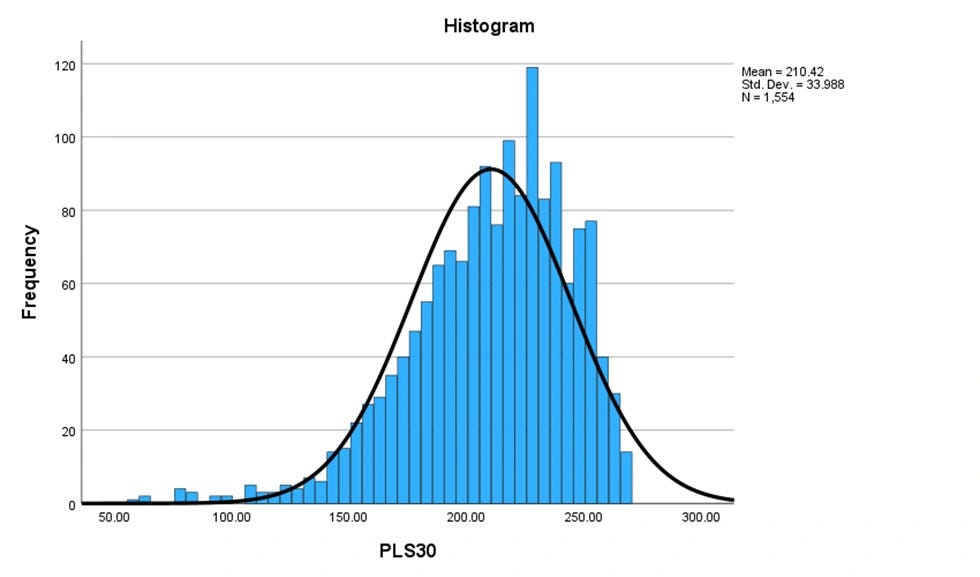
Bode & Kavanaugh (2025) used data from the same survey to show that early-stage romantic love basically divides into four groups, with 29.42% being the most intensely in love. 28.57% of this subgroup (or 8.4% of the study) fell in love before their relationship (as in limerence), but most of them actually fell intensely in love after the relationship started.
This is the basic problem, that Tennov was interested in lovesickness, so she defines “limerence” as the state which leads to this (i.e. starting unfulfilled or unrequited), whereas other academics on love unanimously say these are the same mental state and only differ by the type of situation.
Tennov was probably neurodivergent (see Tennov, 2005, pp. 12, 384–385: “I am the victim of a disorder that adversely influences social interactions”). She’s very intelligent, but her neurodivergence may be why she thinks about mental states in such a different way from other researchers, and why she’s so obstinant about her definition.
Misconceptions
An issue which confuses people about Tennov’s definition is that despite her interest in lovesickness, she does not define limerence in terms of a particular intensity or duration. Instead, she defines limerence as the entire trajectory, starting from the earliest period of attraction into a crush, then either becoming a relationship or a lovesickness.
This means, for example, that if somebody wanted to understand the earliest period of limerence (falling in love), they ought to read the literature on interpersonal attraction and self-expansion, which is meant to cover this. This is stated outright by Aron & Aron (1986, pp. 55, 58–62). The Wikipedia article “Reward theory of attraction” has an overview of this.
Another misconception is that uncertainty is a feature of limerence, but not (supposedly healthy) passionate love. Actually, all infatuated love is believed to rely on uncertainty (Sternberg, 1987), and there is a published theory of how the early stage of a relationship follows this mechanic (Livingston, 1980). Robert Sternberg (1987) related these theories by Tennov and Livingston, with the interpretation of uncertainty as intermittent reinforcement.
Also, if Tennov’s theory is taken to mean that limerence is defined in terms of uncertainty, then limerence and passionate love are virtually synonymous experiences if they both rely on uncertainty. This is a general problem with considering the difference between something like Tennov’s theory and Helen Fisher’s theory (Fisher et al., 2002) which considers limerence and passionate love under one theoretical construct. Are they actually different? Fisher has repeatedly stated that her research is meant to expand on Tennov’s, and that her body of writing is intended to be about this.
Fisher and Tennov had been discussing this in the 1990s. It sounds like Fisher is a limerent herself who basically thinks Tennov is being overly pedantic. In any case, limerence usually refers to the unrequited path in Tennov’s theory.
Obsessive and harmonious passion
“Dualistic model of passion” (DMP) is a psychological theory invented by Robert Vallerand which makes a distinction between two kinds of passion:
- Obsessive passion, wherein one feels a loss of control which interferes with their life.
- Harmonious passion, wherein one feels positive and in control.
DMP is not limited to romance, but research on romantic love has discovered that being in love follows this type of distinction (Acevedo & Aron, 2009; Ratelle et al., 2012; Carswell & Impett, 2021).
Acevedo & Aron (2009) discovered a distinction like this in the PLS, the most common instrument used to measure love feelings. This study found that the PLS (which is unidimensional) actually has two subgroups of questions, which are either obsessive or non-obsessive:
- Obsessive: “Sometimes I feel I can’t control my thoughts; they are obsessively on ____.”
- Obsessive: “An existence without ____ would be dark and dismal.”
- Obsessive: “I get extremely depressed when things don’t go right in my relationship with ____.”
- Non-obsessive: “I want ____ — physically, emotionally, and mentally.”
- Non-obsessive: “For me, ____ is the perfect romantic partner.”
- Non-obsessive: “____ can make me feel effervescent and bubbly.”
Ratelle et al. (2012) designed a DMP measure which has obviously similar items:
- Obsessive: “My mood depends on whether I can see my partner.”
- Obsessive: “I have almost obsessive feelings for my partner.”
- Obsessive: “I have difficulty imagining my life without my partner.”
- Harmonious: “My partner allows me to live memorable experiences.”
- Harmonious: “I’m completely carried away by my relationship with my partner.”
- Harmonious: “The new things that I discover within our relationship allows me to appreciate my partner even more.”
Another measure with a distinction like this is the LAS, with its mania and eros subscales:
- Mania: “When I am in love, I have trouble concentrating on anything else.”
- Mania: “When my lover doesn’t pay attention to me, I feel sick all over.”
- Mania: “When my love affairs break up, I get so depressed that I have even thought of suicide.”
- Eros: “I feel that my lover and I were meant for each other.”
- Eros: “My lover and I became emotionally involved rather quickly.”
- Eros: “My lover and I really understand each other.”
These have all been related in discussions of this (Acevedo & Aron, 2009; Paquette et al., 2020; Carswell & Impett, 2021), although it’s not as clearly explained as it could be. It’s a distinction which has emerged from 2009 onwards.
Limerence is obviously obsessive passion (Hermans, 2025; Carswell & Impett, 2021), but as I discussed earlier, the term is mainly supposed to refer to being in love outside of (or before) a relationship.
Tennov’s definition is also somewhat confusing, because she includes a level of harmonious passion in her trajectory towards fully-intense limerence (Tennov, 1999, p. 44):
The course of limerence is, then, a rise, often very rapid, to a more intrusive thinking pattern than you may ever have experienced. This is invariably an expectant, even joyous period [my note: i.e. of harmonious passion]. It is what Stendhal termed the first crystallization, the initial focusing on LO’s admirable qualities. Then, under appropriate conditions of hope and uncertainty, the limerence intensifies further [my note: i.e. to obsessive passion]. At the peak reached by the first crystallization, perhaps 30 percent of your waking thoughts revolve around LO; at the height of limerence, after what Stendhal called the second crystallization, the figure soars to virtually 100 percent.
(As a side note, I avoid using the term “obsessive love”, because it has a history of also referring to possessive and controlling love, associated with stalking and violence. This is also called “obsessive love disorder”. The Wikipedia article “Obsessive love” has an overview of this idea.)
Something important to understand then is that obsessive romantic passion is not a disorder. It is normal, and academics have even considered the state to be virtually synonymous with “being in love” or “infatuation” (e.g. Acevedo & Aron, 2009):
Passionate love, “a state of intense longing for union with another” (Hatfield & Rapson, 1993, p. 5), also referred to as “being in love” (Meyers & Berscheid, 1997), “infatuation” (Fisher, 1998), and “limerence” (Tennov, 1979), includes an obsessive element, characterized by intrusive thinking, uncertainty, and mood swings.
The reason the terms are not strictly synonymous with “limerence” is that they are also used to refer to other things (called “polysemy”), especially colloquially. “Infatuation”, for example, also has a connotation of having a shallow or superficial basis. Academics on love, however, generally specify what they use a particular term to refer to.
When obsessive passion becomes clinically significant, then it’s supposed to be called a love addiction, and there is a literature on this. Some authors have written about limerence as a type of love addiction, including Stanton Peele himself (Peele, 1988). The “Love addiction” article on Wikipedia has an overview of this. It’s just confusing because some authors on love addiction only talk about relationships.
Tennov does not define “limerence” as necessarily referring to a clinical state, however. She defines it as the entire trajectory (including the earliest period) which potentially leads into something clinical; however, she essentially argues that a clinically-significant state is actually normal, or at least an extension of something normal.
Prevalence estimates for limerence and unrequited love make Tennov’s assertions about this seem very plausible. There are no real prevalence estimates which demonstrate that limerence is rare. I will come back to this later.
Uncertainty
Obsessive passion has been correlated with attachment anxiety (Paquette et al., 2020; Karandashev, 2022), which relates to uncertainty and intermittent reinforcement (Sternberg, 1987; Beckes et al., 2016).
As I mentioned earlier, this is believed to be common during the early period of a relationship (Livingston, 1980; Dugan et al., 2024). It’s supposed to clear up as the relationship becomes more secure, hence why “passion” fades under the attachment lens (Sternberg, 1987). If the relationship doesn’t become secure, then the obsessive state continues, and relationship satisfaction decreases over time (Acevedo & Aron, 2009; Graham, 2010; Hendrick & Hendrick, 2006, pp. 156–157).
However, obsessive passion in the early period of a relationship does not necessarily mean the relationship is toxic. It’s only when it continues over time (fueled by insecurity of some kind) that it seems to be a problem.
The mechanics of intermittent reinforcement (or more specifically, variable-ratio reinforcement) do not necessarily require reciprocation to literally alternate (as in push-pull/hot-cold dynamics, or intermittent maltreatment i.e. trauma bonding). It can also be that the lover (or limerent object) is merely encountered infrequently or unexpectedly (Hayes, 2000; Sternberg, 1987; see Catriona, 2026 for a story).
Note that while there is not a study explicitly testing how intermittent reinforcement affects love feelings, there are studies on uncertainty and addiction (Robinson & Berridge, 2025) and one very good study on uncertain interactions between strangers (Beckes et al., 2016). Patrick Anselme (2015) developed a mathematical model for how this intensifies incentive salience, involving a concept called “incentive hope”. There is also a brain scan experiment on reward prediction error (reversal of expectation) in relationships (Poore et al., 2012), and the primary author relates this to limerence theory in his dissertation (Poore, 2009).
There is a very strong theoretical basis to believe that uncertainty intensifies feelings of passionate love (obsessive passion).
A common misconception is that because obsessive passion relates to attachment anxiety and intermittent reinforcement, then it’s not “really” love. It’s a misunderstanding because for intermittent reinforcement to work, the object of desire also has to be rewarding (Anselme, 2015). The only catch is that this reward association can be based on a fantasy, or in some cases even a mistake. Again, please read “Reward theory of attraction” for an introduction to this research.
Self-expansion is an ostensibly healthy source of reward in relationships (Emery et al., 2025), and while it’s believed to relate to harmonious passion (Carswell & Impett, 2021), it’s also actually been correlated with LAS mania (Sheets, 2013), i.e. obsessive passion. Sheets showed that self-expansion was associated with eros (harmonious passion) much more over time, although this might be suspect because the eros subscale has questions which are retrospective (e.g. “My lover and I were attracted to each other immediately after we first met”).
The Arons (1986, pp. 58–59) also originally speculated that self-expansion is a reason people fall into limerence.
In summary, it’s well-established that the obsessive–harmonious distinction relates to the anxous–secure distinction, but it’s not a simple dichotomy. Uncertainty basically requires some reward association to have an effect (you have to like the person at some level, or at least care what they think about you), and it’s also not necessarily the case that uncertainty means a relationship is literally or potentially toxic.
How to understand research on limerence
To briefly review, limerence is defined as an obsessive kind of infatuation which starts before a relationship, and has the potential to become a clinical issue, but also (probably unusually) lead to a relationship and settle down if the relationship is secure.
The vast majority of academics on love do not seem to think the distinction between being inside vs. outside a relationship is important to understanding unrequited love. In other words, while there are very few studies on unrequited love (Bringle et al., 2013), it is perfectly reasonable to use studies on people in relationships to make inferences about the unrequited scenario.
From relationship studies, for example, we know that obsessive infatuation is related to attachment anxiety (Paquette et al., 2020; Karandashev, 2022), and tends to make people unhappy as it continues over time (Acevedo & Aron, 2009; Graham, 2010). The relation to attachment anxiety is also demonstrated with attempted measures of limerence (Feeney & Noller, 1990; Wolf, 2017).
The only thing that nobody really knows anything about is the long-term trajectory of limerence outside of a relationship.
Arthur Aron has related a theory that uncertain reciprocation makes unrequited love hard to extinguish, which predicts a relationship between intermittent reinforcement and the duration of limerence (Aron, Aron & Allen, 1998):
Tennov (1979) interviewed a large number of individuals who experienced a state of unreciprocated love so extreme that many found their lives entirely disrupted by it. Others have described unreciprocated love as a clinical syndrome (Mintz, 1980; Pizer, 1985). … Wong and Pfeiffer (1989) … argued that unreciprocated love, once begun, may be maintained by motivated misreadings of the beloved’s responses, which creates a partial reinforcement schedule that is very hard to extinguish.
This is the same as the comparison to gambling addiction that is so popular today.
In addiction, a transition occurs from an earlier stage which involves more positive reinforcement (binging and intoxication) to a later stage which involves more negative reinforcement (avoiding withdrawal). The negative reinforcement in this later stage makes it more closely resemble OCD (Koob & Volkow, 2016). A similar transition has been hypothesized in romantic love (Burkett & Young, 2012; Bode & Kushnick, 2021).
We don’t have an experiment testing this, but in other words the romantic love research literature has already published a theory of late-stage OCD-like limerence (that it’s the later stage of a love addiction). Sandra Langeslag (2024) found that the vast majority of people who responded to her survey of internet communites reported that limerence was unwanted (they wanted less of it and/or did not like thinking about their LO), but there is already a decent theory of this. Langeslag has commented that limerence is passionate love (McCracken, 2026).
Amazingly, Frank Tallis (2005, pp. 216–217) already related this transition to a discussion of limerence as an addiction. Tallis is the clinical psychologist specializing in OCD who wrote a book arguing that lovesickness ought to be taken more seriously by the field.
My question is basically this: what exactly counts as “research” when people talk about “research on limerence”? Experiments? Theories? It’s all very pedantic.
There is already an entire published theory of what it is and how it works, often even using the term “limerence”. Anyone could just read that literature and understand it. We are just lacking a few key experiments testing it. In particular, there is not an experiment explicitly testing if variable-ratio reinforcement increases the duration of romantic love, nor an experiment testing whether an unrequited love addiction becomes more OCD-like over time. However, the theories are already published, by very prominent authors no less.
Basically, anyone who claims there isn’t research on limerence and then somehow implies that reading the literature on romantic love wouldn’t explain it is just hiding the information from people. I think it’s not a coincidence that this claim that there “isn’t” research is often paired with an advertisement (“buy my book”).
Brain scans
Aron et al. (2005) is the paper on Helen Fisher’s “madly in love” brain scan experiment. The team went to great lengths to make sure the participants were really experiencing the obsessional state (Fisher et al., 2002). “All participants also reported that they spent more than 85% of their waking hours thinking of their beloved” (Fisher et al., 2016).
Joe Beam (Marriage Helper, 2025) has characterized this experiment as a limerence brain scan, although it is more accurately a brain scan of what Tennov calls the “ecstatic union” (people in relationships).
Fisher et al. (2008) is the classic unrequited love brain scan, which also made sure people were really experiencing an extreme obsessional state, although the participants were ex-partners. According to many definitions of “limerence” that I’ve seen, this would actually qualify as an unrequited limerence (or even “limerence disorder”) brain scan experiment.
So, if anyone defines “limerence” as just being like an obsession that causes inordinate distress (including obsession with an ex-partner), but then claims there is not research, they are using a logical fallacy called “equivocation” or “motte and bailey” where they jump between different definitions in different contexts.
Only Tennov’s most pedantic definition (before a relationship) excludes this as a study “on limerence”. But again, nobody with credentials in love research seems to believe the distinction is all that important.
Why people think there isn’t research
In 2008, a fringe author named Albert Wakin began trying to argue that limerence ought to be added to the DSM. In 2011, Wakin also began claiming that only 5% of the population have experienced limerence (e.g. O’Shea, 2011).
However, this does not come from any kind of a survey. I was even able to confirm this through a researcher who asked Wakin about this.
In even older articles, it’s revealed that Wakin actually did a survey in which he estimated to USA Today that about 25–30% experienced limerence (Jayson, 2008). In an article just one week prior to that (Katz, 2008), Wakin even seems to estimate 50%, because he reports a (different) number of about 100 participants. The USA Today article (again, only one week later) reports his survey size was about 200.
However, for some reason from 2008 to 2011, this became 5%.
The 25–50% figure is similar to other actual estimates, for example, Tennov (1999, pp. 149, 209–210, 212) and Bellamy (2025, p. 80). There are quite a lot of surveys which are suggestive of this kind of number. Many are mentioned in the Wikipedia articles at the top. 25% is probably a perfectly good estimate of limerence involving a clinical level of distress. To get a much smaller estimate, somebody would have to design a survey very carefully, using a very restrictive definition.
Note also that Helen Fisher is seen specifically commenting on Wakin & Vo in the USA Today article, saying that limerence is romantic love. Fisher uses “romantic love” as a synonym for passionate love in her theory.
In the earlier article (Katz, 2008), Wakin acknowledges several common aliases for limerence, including “love madness”, which Fisher & Aron were the actual preeminent experts on at the time:
Wakin said a predisposition for limerence is probably hard-wired into the brain, and has been with humans for millenniums, who have called it love sickness, love madness, puppy love and many other names.
It’s also confusing that in several articles (e.g. Jayson, 2008; O’Shea, 2011; Lehr, 2016) Wakin has clearly stated that he is talking about people in relationships:
The object of the obsession will usually tire of all the attention and neediness, but attempts to create distance — up to and including a breakup — only make the obsession worse. In the worst cases, Wakin said, people he’s surveyed and spoken with will have their partners (or exes) on their mind up to 95 percent of the time. (Lehr, 2016)
Note that I’ve also reviewed actual research here which shows this is related to anxious attachment. If Wakin is talking about people in relationships, then there are literally studies on that.
His paper also clearly frames limerence in terms of a relationship (Wakin & Vo, 2008). Again, I just find this confusing, as a reader trying to understand what all these different authors were talking about. Nowadays, limerence is generally discussed as being unrequited.
In another later article (Haward, 2017), Wakin states that he was trying to get funding for brain scans, but he includes people in relationships in his definition again. Brain scans had already been done on people in relationships (Aron et al., 2005), and ex-partners (Fisher et al., 2008). This goes back to what I said earlier about equivocation, or motte and bailey. The brain scans that were done actually seem to meet his definition of “limerence”. In that article (Haward, 2017), Wakin also gives an incorrect definition for “love addiction”.
Now, I don’t think that Wakin has outright stated that there is little research on limerence, only that “the professional community, particularly clinical, is largely unaware of the concept” (Wakin & Vo, 2008).
I believe the idea (the myth) originates from Lynn Willmott, who states in her paper that “It seemed that … information and research into Limerence was limited” (Willmott & Bentley, 2015).
However, Willmott & Bentley have a self-published book (originally published in 2012) in which they were perfectly aware of the extent of the research in that time (citing all the brain scans, Love Sick by Tallis, Breaking Hearts by Baumeister & Wotman, etc.).
Additionally, Willmott & Bentley are perfectly open that limerence is in fact lovesickness, unrequited love, etc. (Willmott & Bentley, 2014):
Limerence may be aligned to infatuation, lovesickness, romantic love, love addiction, obsessive love, or affection deficit disorder, as well as faux love and in love with being in love. (p. 1)
Additionally, Baumeister & Wotman (1992) suggests that attachment theory is a useful perspective for unrequited love [limerence] in that it tracks a path of rejection. (p. 32)
This book is very difficult to obtain because it was allowed to go out of print, but I have a copy of the 2014 version.
As a result of the very misleading claim in their paper (Willmott & Bentley, 2015), people misunderstand and never go looking for other authors who have written about limerence. In fact, many authors had at least written about it prior to this, even sometimes from a clinical perspective. As I reviewed earlier, passionate love research is also supposed to be relevant to this, whether it mentions the term “limerence” or not.
There is a master’s thesis by Noah Wolf (2017) which attempted to argue that limerence and passionate love are actually different constructs, but his arguments are all either incorrect or misleading, and actually contradicted by his own citations.
Wolf claims that “Nowhere is uncertainty discussed as an aspect of passionate love”, but this is incorrect. I’ve already refuted it here. It is also contradicted by Wolf’s own citation (Acevedo & Aron, 2009), quoted earlier, which mentions uncertainty.
Even Tennov (1999, p. 56) says this herself:
The recognition that some uncertainty must exist has been commented on and complained about by virtually everyone who has undertaken a serious study of the phenomenon of romantic love.
“Virtually everyone”, according to Tennov.
Wolf also discusses fear of rejection, but this is generally interpreted as attachment anxiety, and I reviewed earlier how this does relate to passionate love. The PLS even asks about fear of rejection (“An existence without ____ would be dark and dismal”), in accordance with Tennov’s definition. Actually, Tennov (1999, pp. 209–210, 212) uses a question like this to estimate the prevalence of limerence: “I was (am) terribly afraid that ____ would stop loving me”.
Wolf’s claims about the unsuitability of the PLS for measuring limerence are true, but they are acknowledged by his own citation (Langeslag et al., 2012). Basically, somebody should design a questionnaire which measures obsessive and harmonious passion, but which is suitable for unrequited love (which Ratelle’s isn’t). Wolf’s questionnaire actually doesn’t do this (it asks about too many things), and his studies show that it’s difficult to interpret what it measures.
I think that Wolf just misread things, and didn’t do enough reading to fully understand how the concepts are supposed to relate.
I should also point out that these original papers were not peer reviewed. Wakin & Vo (2008) was not even published in a journal. TQR, the journal Willmott & Bentley (2015) was published in, has an editorial disclaimer that the “hallmark of The Qualitative Report will not be built upon rejection rates” and that sometimes “quality is not readily apparent in the text”. Neither of these are acceptable to be cited on Wikipedia, for example, which is part of why I got interested in this. There are issues with peer review, but it matters here that all the papers written by actual experts say something different.
Quotes
Finally, I want to list a few notable quotes about this, because people should understand that these are really authors talking about limerence per se, not people using it as a synonym for “being in love”.
Arthur Aron & Elaine Aron (1986, p. 59):
Tennov (1979) presented an extensive collection of subjects’ interview descriptions of an intense romantic love she labeled “limerence.” Limerence involves constant, overwhelming, and even debilitating absorption in the unrequited desire for reciprocation of equally intense feelings from a love object.
Stanton Peele (1988, pp. 164–165):
Tennov’s concern is with a severe emotional disability, one that leads people (primarily women) desperately to pursue often inappropriate love objects, frequently to fail at relationships, and to be incapable of learning from such experiences so that their ardor and desperation are often increased by their failures at love. Overall, they experience love as painful and futile, a clinical condition…
John Money (1997, p. 133):
…the all consuming preoccupation with unrequited limerence persists, at the expense of scholastic achievement or job performance. In the case of a college student, he/she can’t get out of bed on time, can’t keep on schedule for class instruction, can’t concentrate on studying, can’t finish assignments, and can’t halt failing grades, but mopes around alone, too often unable to socialize, and falls into tears if trying to account for what has gone wrong.
Among college and university students, lovesickness of this incapacitating type is a good candidate for the syndrome that most frequently escapes diagnosis. It has no officially recognized name, and is not listed in textbooks or diagnostic manuals.
Frank Tallis (2005, pp. 42–43):
Dorothy Tennov began a research programme that eventually resulted in the identification of a form of love similar to Lee’s mania. Tennov called it limerence — to distinguish it from other concepts of love — and it corresponds with mental states conventially described as ‘being in love’ or ‘falling in love’. The principal features of limerence are obsession, irrational idealisation, emotional dependency and a deep longing for reciprocation. Typically, the limerent individuals pursue inappropriate partners, fail at relationships and seem unable to learn from their experience. Moreover, like manic lovers, they are often compulsively attracted to partners who are objectively unsuitable. Given that the limerent individual does not learn from experience, he or she is likely to become trapped in a repeating cycle of unhappy relationships. Consequently, limerence is characterised by significant distress and a sense of futility.
References
- Acevedo, B. & Aron, A. (2009). Does a Long-Term Relationship Kill Romantic Love? (ResearchGate)
- Acevedo et al. (2011). Neural correlates of long-term intense romantic love. (Article)
- Anselme, P. (2015). Incentive salience attribution under reward uncertainty: A Pavlovian model. (Abstract)
- Aron, A. & Aron, E. (1986). Love and the Expansion of Self: Understanding Attraction and Satisfaction. (Archive)
- Aron, A., Aron, E. & Allen, J. (1998). Motivations for Unreciprocated Love. (Abstract)
- Aron et al. (2005). Reward, Motivation, and Emotion Systems Associated With Early-Stage Intense Romantic Love. (Article)
- Beckes et al. (2016). Desperately Seeking Support: Negative Reinforcement Schedules in the Formation of Adult Attachment Associations. (Abstract)
- Bellamy, T. (2025). Smitten: Romantic obsession, the neuroscience of limerence, and how to make love last. (Google Books)
- Bode, A. & Kushnick, G. (2021). Proximate and Ultimate Perspectives on Romantic Love. (Article)
- Bode, A. & Kavanaugh, P. (2025). Variation exists in the expression of romantic love: A cluster analytic study of young adults experiencing romantic love. (Article)
- Bringle et al. (2013). The Prevalence and Nature of Unrequited Love. (Article)
- Burkett, J. & Young, L. (2012). The behavioral, anatomical and pharmacological parallels between social attachment, love and addiction. (Article)
- Carswell, L. & Impett, E. (2021). What fuels passion? An integrative review of competing theories of romantic passion. (Article)
- Catriona, I. (2026). Longing for someone you barely know? A neuroscientist explains how to overcome limerence. (Article)
- Dugan et al. (2024). Testing the canalization hypothesis of attachment theory: Examining within-subject variation in attachment security. (Abstract)
- Emery et al. (2025). Self-Expansion Theory: Origins, Current Evidence, and Future Horizons. (Article)
- Feeney, J. & Noller, P. (1990). Attachment style as a predictor of adult romantic relationships. (ResearchGate)
- Fisher et al. (2002). Defining the Brain Systems of Lust, Romantic Attraction, and Attachment. (ResearchGate)
- Fisher et al. (2008). Reward, Addiction, and Emotion Regulation Systems Associated With Rejection in Love. (Article)
- Fisher et al. (2016). Intense, Passionate, Romantic Love: A Natural Addiction? How the Fields That Investigate Romance and Substance Abuse Can Inform Each Other. (Article)
- Graham, J. (2010). Measuring love in romantic relationships: A meta-analysis. (Abstract)
- Hatfield, E. (1988). “Passionate and Companionate Love”. The Psychology of Love. (Google Books)
- Haward, J. (2017). “Can You Be Addicted To Love? We Take A Look At Limerence”. HuffPost. (Article)
- Hayes, N. (2000). Foundations of Psychology 3rd Edition. (Google Books)
- Hendrick, C. & Hendrick, S. (2006). “Styles of Romantic Love”. The New Psychology of Love. (Google Books)
- Hermans, H. (2025). “From Obsessive to Harmonious Passion”. Psychological Richness As Breakthrough. (Abstract)
- Jayson, S. (2008). “‘Limerence’ makes the heart grow far too fonder”. USA Today. (Archive)
- Karandashev, V. (2022). Adaptive and Maladaptive Love Attitudes. (ResearchGate)
- Katz, A. (2008). “Long-term infatuation, little studied”. Elm City Express. (Article)
- Koob, G. & Volkow, N. (2016). Neurobiology of addiction: a neurocircuitry analysis. (Abstract)
- Langeslag et al. (2012). Measuring Romantic Love: Psychometric Properties of the Infatuation and Attachment Scales. (ResearchGate)
- Langeslag, S. (2024). Limerence: Definition, Experience, and Regulation. (YouTube)
- Lehr, N. (2016). “Limerence: The potent grip of obsessive love”. CNN. (Article)
- Livingston, K. (1980). “Love as a Process of Reducing Uncertainty — Cognitive Theory”. On Love and Loving. (Archive)
- Marriage Helper. (2025). What is Limerence? Limerence Meaning and Definition. (Article)
- McCracken, A. (2026). I Was a Virgin at 41 — and It Had Nothing to Do With Sex: How I broke up with limerence for good. (Article)
- Money, J. (1997). Principles of Developmental Sexology. (Google Books)
- O’Shea, S. (2011). “Lovesick? You Might Have a Legit Illness”. Marie Claire. (Article)
- Paquette et al. (2020). Why are you passionately in love? Attachment styles as determinants of romantic passion and conflict resolution strategies. (ResearchGate)
- Peele, S. (1988). “Fools for Love”. The Psychology of Love. (Google Books)
- Poore, J. (2009). On the role of reward-related prediction-error and uncertainty in romantic passion and adult pair bonding. (Preview)
- Poore et al. (2012). Prediction-error in the context of real social relationships modulates reward system activity. (Article)
- Ratelle et al. (2012). Passion in the romantic sphere: A look at relational outcomes. (Abstract)
- Robinson, T. & Berridge, K. (2025). The Incentive-Sensitization Theory of Addiction 30 Years On. (Article)
- Sheets, V. (2013). Passion for life: Self-expansion and passionate love across the life span. (Article)
- Sternberg, R. (1987). Liking versus loving: A comparative evaluation of theories. (Abstract)
- Tallis, F. (2005). Love Sick: Love as a Mental Illness. (Google Books)
- Tennov, D. (1999). Love and Limerence: The Experience of Being in Love. (Google Books)
- Tennov, D. (2005). A Scientist Looks at Romantic Love and Calls It Limerence: The Collected Later Works of Dorothy Tennov. (Publisher)
- Wakin, A. & Vo, D. (2008). Love-Variant: The Wakin-Vo I. D. R. Model of Limerence. (Article)
- Willmott, L. & Bentley, E. (2014). Love and Limerence: Harness the Limbicbrain. (Google Books)
- Willmott, L. & Bentley, E. (2015). Exploring the Lived-Experience of Limerence: A Journey toward Authenticity. (Article)
- Wolf, N. (2017). Investigating Limerence: Predictors of Limerence, Measure Validation, and Goal Progress. (Article)
Comments
Post a Comment